A facelift consultation runs on the questions the patient brings into the room. Sugar Land residents and others in Fort Bend County who are considering the surgery can make that appointment more useful by arriving with a short, specific list.
Leo Lapuerta, MD, FACS, a triple board-certified plastic surgeon based in Houston, sees patients from Sugar Land for facelift surgery near Sugar Land. His practice has offices in Houston, Katy and Pearland, and he performs surgery at the Plastic Surgery Institute of Southeast Texas, the AAAASF accredited facility he opened in Pearland in 2003. The questions below draw on the practice’s own published facelift guidance.
Know which facelift is on the table
The word facelift covers several operations. The practice describes a mini facelift for earlier aging with mild loose skin and early jowls, a traditional facelift for more visible signs of aging, and a SMAS facelift that works on the support layer beneath the skin. It also describes a deep plane facelift, which releases and repositions deeper tissues as a unit, and an extended deep plane version for cases that need a broader release. A revision facelift corrects or refines earlier facelift surgery.
The practice states that the right technique depends on where the laxity is, how advanced it is, and what correction will look believable on a given face. The extended deep plane approach, the practice notes, is better only when it fits the anatomy in front of the surgeon.
Questions about your own face
- Does my degree of laxity call for a mini, traditional, SMAS or deep plane lift, and why? The answer should reference the jawline, cheeks and neck, which the practice says it assesses together.
- Does my neck need treatment too? The practice notes that patients with neck laxity often need a neck lift at the same time for a cleaner result.
- Will a lift address my main complaint? The practice lists limits: a facelift does not replace skincare, does not erase pigment changes from sun exposure, and may not fully correct poor skin quality, etched lines or volume loss alone. Fat transfer or skin resurfacing may be part of the plan.
- Can you show me the incision plan? The practice places them around the ears and within the hairline where possible. Ask whether your history of scarring changes anything.
- Can you walk me through recovery week by week? Swelling and bruising peak in the first few days, contours look more polished after several weeks, and final results refine as residual swelling fades and scars mature.
Questions about the surgeon and the setting
Dr. Lapuerta has a stated view on what to look for. “The best way to ensure a good outcome is to choose a surgeon who is qualified (board certified) and has extensive surgical experience in both number of cases and years of experience,” he says. In his view, experience performing the specific procedure, together with board certification, is the best determinant of a result patients are happy with.
- Are you board certified, and by which boards? Dr. Lapuerta holds certification from the American Board of Plastic Surgery, the American Board of Surgery, and in Surgery of the Hand.
- Can you tell me how many procedures you have performed, and over how many years? He reports more than 30,000 surgical and non-surgical procedures over more than 30 years.
- Can I see results? The practice has more than 3,000 before-and-after images available for patients to review.
- Is the surgical facility accredited, and who gives the anesthesia? Dr. Lapuerta owns and operates a QuadA accredited surgical facility and works with physician anesthesiologists, never nurse anesthetists or anesthesia assistants. According to the practice, many facelifts are performed under general anesthesia.
The visit itself
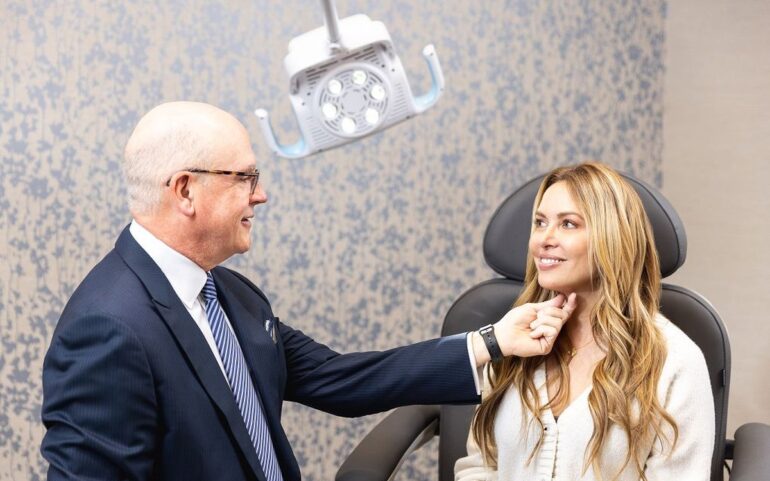
The practice describes a consultation that covers goals, surgical options, incision placement, anesthesia options, aftercare and recovery. On surgery day, staff greet patients and take them to a private room, and after the procedure patients leave through a private door. The team follows up with phone calls and appointments to track progress.
Dr. Lapuerta is a native Spanish speaker, fluent in English, with bilingual support staff. He serves as Chairman of Plastic Surgery at St. Joseph Hospital in Houston.
Every facelift carries risks, and the practice lists situations where the surgery may not fit: a main concern of texture over laxity, a wish for zero downtime, skin quality poor enough to affect healing, or expectations that are not realistic. A Sugar Land patient who walks in with the questions above, plus a list of current medications and any past facial procedures, gives the consultation what it needs to reach a specific plan.
This article is for general information only and is not medical advice. Results vary from patient to patient. Consult a board-certified plastic surgeon or your physician about your own situation. Written in partnership with Joseph Lambert, a publicist working with Leo Lapuerta, MD Plastic Surgery.